Pearson Edexcel · A-Level · English Literature
Course version: 9ET0 · Version from Sept 2015
Poetry – Section B: Specified Poetry Pre- or Post-1900 – Post-1900 – The…
Full specification wording
Component 3: Poetry – Section B: Specified Poetry Pre- or Post-1900 – Post-1900 – The Modernist Period – T S Eliot: Selected Poems (Faber, 2009): Ariel Poems: Journey of the Magi (1927)
Journey of the Magi is a dramatic monologue exploring the psychological and spiritual cost of religious conversion.
Checked against the Pearson Edexcel 9ET0 specification (opens in a new tab) on .
- Point 7 of 7
- 4 key terms
Study notes
From the checked teaching notes for this specification point.
The idea
Journey of the Magi is a dramatic monologue exploring the psychological and spiritual cost of religious conversion. Narrated by one of the biblical Magi years after visiting the infant Christ, the poem demythologises the nativity story, focusing instead on the physical hardships of the journey and the profound alienation experienced upon returning home. The poem requires evaluation of how the Magus’s realization that the birth of Christ meant the 'Death' of his own culture reflects Eliot’s own difficult transition into the Anglican faith.
What earns the marks
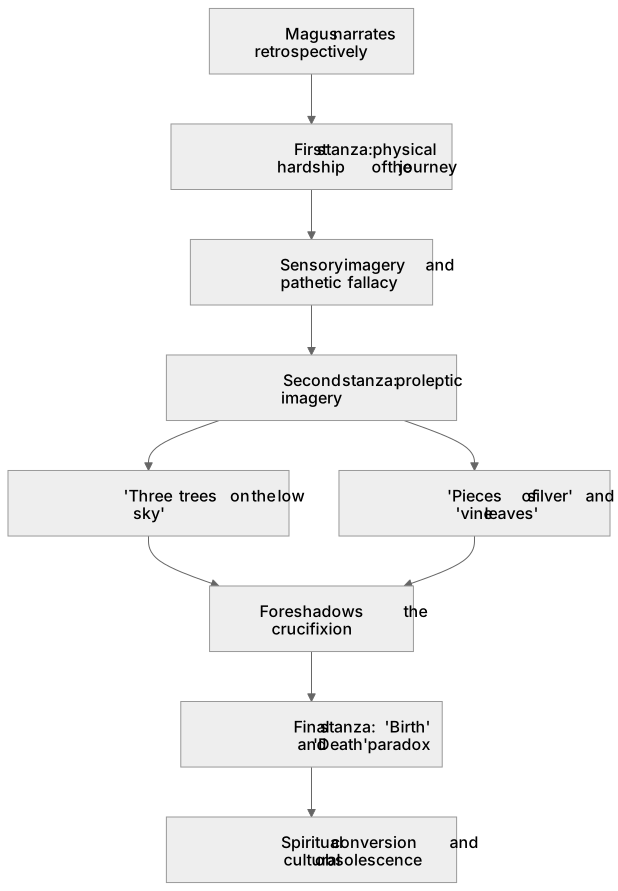
- Analyse the dramatic monologue form and the retrospective narrative voice of the Magus to explore themes of alienation and memory.
- Evaluate the use of sensory imagery and pathetic fallacy in the first stanza to depict the physical and spiritual arduousness of the journey.
- Examine the proleptic imagery in the second stanza (such as 'pieces of silver' and 'vine leaves') that foreshadows the life, betrayal, and crucifixion of Christ.
- Assess the paradoxical relationship between 'Birth' and 'Death' in the final stanza as a metaphor for spiritual conversion and cultural obsolescence.
Common mistakes and how to put them right
Reading the poem as a traditional, joyful Christmas narrative.
Put it right: Focus on the poem's melancholic tone, the physical suffering described, and the Magus's ultimate sense of displacement.
Missing the significance of the quotation marks in the opening lines.
Put it right: Identify that the opening lines are adapted from a 1622 nativity sermon by Lancelot Andrewes, establishing an intertextual depth.
Confusing the 'Death' mentioned at the end with literal mortality.
Put it right: Explain that this 'Death' refers to the end of the pagan era and the Magus's previous way of life, which has been rendered obsolete.
Exam tips
- Contrast the colloquial, weary tone of the Magus with the momentous nature of the historical event to highlight Eliot's Modernist approach to myth.
- Track the shift in pronouns and tense throughout the poem to demonstrate how the Magus's personal experience becomes a universal reflection on faith.
- Link the poem's themes of painful transition to Eliot's own contemporary conversion to Anglo-Catholicism in 1927.
Try the lesson
The start of the Component 3: Poetry – Section B: Specified Poetry Pre- or Post-1900 – Post-1900 – The Modernist Period – T S Eliot: Selected Poems (Faber, 2009): Ariel Poems: Journey of the Magi (1927) lesson, made from checked teaching notes for this specification point.
Have a go first
What is the primary source material that T.S. Eliot adapts for the opening lines of 'Journey of the Magi'?
Listen
Journey of the Magi is a dramatic monologue exploring the psychological and spiritual cost of religious conversion. Narrated by one of the biblical Magi years after visiting the infant Christ, the poem demythologises the nativity story, focusing instead on the physical hardships of the journey and the profound alienation experienced upon returning home. The poem requires evaluation of how the Magus’s realization that the birth of Christ meant the 'Death' of his own culture reflects Eliot’s own difficult transition into the Anglican faith. A strong answer earns marks for these points. Analyse the dramatic monologue form and the retrospective narrative voice of the Magus to explore themes of alienation and memory. Evaluate the use of sensory imagery and pathetic fallacy in the first stanza to depict the physical and spiritual arduousness of the journey. Examine the proleptic imagery in the second stanza (such as 'pieces of silver' and 'vine leaves') that foreshadows the life, betrayal, and crucifixion of Christ. Assess the paradoxical relationship between 'Birth' and 'Death' in the final stanza as a metaphor for spiritual conversion and cultural obsolescence. A common slip: Reading the poem as a traditional, joyful Christmas narrative. Instead, Focus on the poem's melancholic tone, the physical suffering described, and the Magus's ultimate sense of displacement. Exam tip: Contrast the colloquial, weary tone of the Magus with the momentous nature of the historical event to highlight Eliot's Modernist approach to myth.
See it
Key words
Say what each word means before you turn the card.
Spiritual alienation
Try answering aloud or in your head before turning the card.
The cost of conversion
Try answering aloud or in your head before turning the card.
Birth and death
Try answering aloud or in your head before turning the card.
The intersection of time and eternity
Try answering aloud or in your head before turning the card.
See every definition
- Spiritual alienation
- The profound alienation the Magus experiences upon returning home after visiting the infant Christ.
- The cost of conversion
- The psychological and spiritual cost of religious conversion explored through the Magus's experience.
- Birth and death
- The paradoxical relationship in the final stanza used as a metaphor for spiritual conversion and cultural obsolescence.
- The intersection of time and eternity
- The collapsing of time achieved through anachronistic imagery such as the 'three trees on the low sky' foreshadowing the crucifixion.
Label the diagram
Some boxes have lost their names. Pick the right name for each number.
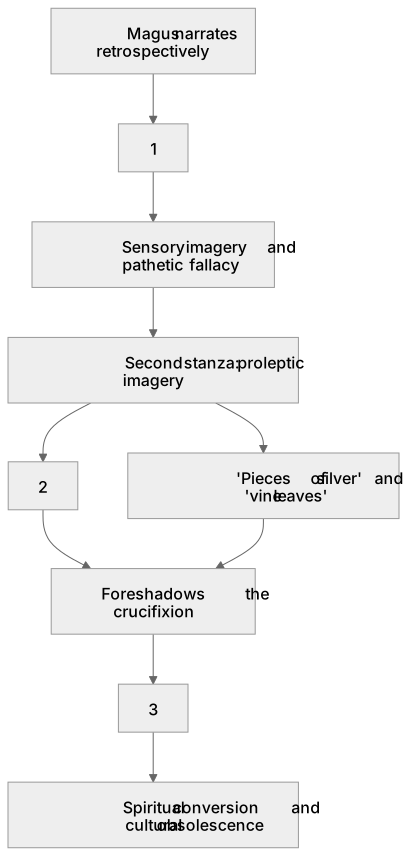
1Box 1
2Box 2
3Box 3
There is more to this lesson
The full lesson goes on to check your understanding and help you earn the marks. Create a free account to carry on, with your progress saved.
A week of Premium from your first lesson · Then the free plan continues · No card, no charge
Test your understanding of Component 3: Poetry – Section B: Specified Poetry Pre- or Post-1900 – Post-1900 – The Modernist Period – T S Eliot: Selected Poems (Faber, 2009): Ariel Poems: Journey of the Magi (1927)
Active recall beats re-reading. Take an instant quiz now to test what you’ve learned and lock it into long-term memory.
A week of Premium from your first lesson · Then the free plan continues · No card, no charge